
When many of us think about fungi, we tend to think of decay and disease. There are, of course, many pathogenic fungi that have a significant impact on human, animal and plant health. However, fungi are also the unsung heroes in many aspects of our life, including food production and other important breakthroughs in medicine and household products (such as detergents).
Continue readingCategory: New data and web features
Update to the Ensembl Canonical transcript set
Upcoming Ensembl release 104 will bring an update to the Ensembl Canonical transcripts. The new Ensembl Canonical definition will prioritise well-supported biologically representative, highly expressed and highly conserved transcripts. MANE Select will be used as the canonical transcript for human protein coding genes where available.
Continue readingRetirement of clone-based gene names
Human, mouse, rat and zebrafish genes without an official gene symbol, have been conventionally named after BAC clones in Ensembl. We plan to remove these names in Ensembl release 104 and resort to using the Ensembl gene stable IDs instead, in line with practices adopted for all other vertebrate species.
Continue readingMANE progress update
NCBI and EBI have been hard at work on our joint MANE collaboration, aiming to provide a set of representative transcripts for human protein-coding genes that are identically annotated in the NCBI RefSeq and Ensembl/GENCODE annotation sets and exactly match the GRCh38 reference assembly. We released MANE v0.5 in Dec 2018, which included one well-supported MANE Select transcript for 53% of the human protein-coding genes. The remainder has required a lot more analysis and curation than we expected, but we’re pleased to announce MANE v0.92, now covering 16,865 genes or ~88% of known protein-coding genes. We’ve been focussing on clinically relevant genes and MANE Select now includes 99% of genes with high gene-disease validity. This release also includes 43 extra transcripts labeled “MANE Plus Clinical” that have been chosen to aid in clinical reporting, for example when there are additional pathogenic or likely pathogenic variants not covered in the MANE Select transcript. For example in genes where there are mutually exclusive exons and both exons have clinically relevant variants, a MANE Plus Clinical transcript will be added alongside the MANE Select transcript so that both exons are represented in MANE.
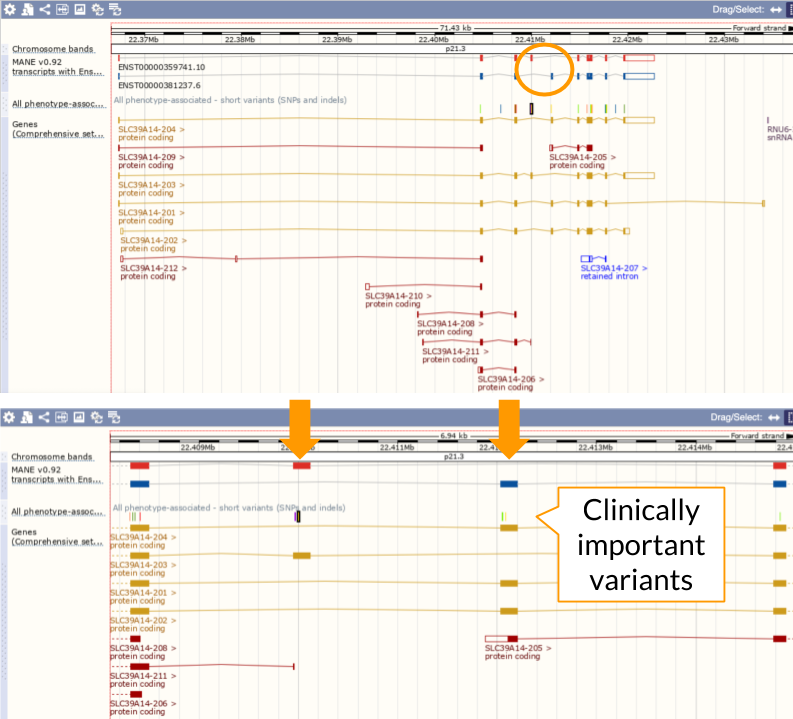
While it’s critical to consider other alternatively-spliced transcripts for variant interpretation or functional analyses, the MANE Select and MANE Plus Clinical transcripts provide a common foundation for clinical reporting, and other analyses that benefit from using just one well-supported transcript or protein per gene.
MANE Select is now shown in the genome aggregation database gnomAD v3, is displayed and used as the preferred transcript for variant reporting in ClinVar and is displayed in DECIPHER. We have released this data as a trackhub for display in the Ensembl, NCBI and UCSC genome browsers. MANE Select v0.92 transcripts will be available in Ensembl release 103 due in the Spring 2021, and will be included in BioMart and VEP.
Partnership with the community is really important to us. We value your feedback. If you are interested in working with us, please contact us at MANE-help@ebi.ac.uk.
Ensembl Bacteria updates
The genome annotation data available in Ensembl Bacteria was extensively updated in Ensembl 102/ Ensembl Genomes 49
Continue readingEnsembl Rapid Release
We are excited to announce the launch of the Ensembl Rapid Release website. Ensembl Rapid Release is a new, lightweight genome browser designed to allow quick release of the latest genome annotation for a large number of vertebrate and non-vertebrate species.
Continue readingComing soon to an Ensembl near you: dbSNP 2.0
NCBI has announced big changes to how dbSNP manages human variation data, which will be reflected in Ensembl. These changes include a new allele normalisation approach and the removal of some older population genetics data.
Your input into Ensembl’s new design
Work continues on our exciting new website, which is available as a pre-alpha release. We’ve been consulting with some of you in various ways, such as interviews and meetings, because we want to make sure that the new Ensembl serves your needs. We’re now asking for your help with a short survey, which will just take a couple of minutes to fill in. Plus, you can enter into a draw to win an EMBL-EBI t-shirt.
What’s coming in Ensembl 97 & Ensembl Genomes 44
Both Ensembl release 97 and Ensembl Genomes release 44 are scheduled for mid- to late-June.
Included are a number of new livestock, fish, metazoan, plant, and protist genomes and genebuilds, as well as updates to the mouse and human GENCODE annotation and the human regulatory build.
Read on to see further details of the new data you can look forward to.
We are making ‘MANE’ changes…
The RefSeq column on our gene pages has changed.
We’re moving towards a more unified gene-set with RefSeq, with biologically important transcripts being highlighted as MANE. This means displays you’re used to seeing will be updated to reflect these changes, and this may affect the way you have been working with Ensembl.